In response to operations employed by immigration enforcement, Los Angeles Unified School District (L.A.U.S.D.) has expanded their policies in order to maintain the safety of marginalized students.
The District’s efforts to revise protective policy occurred after multiple hostile interactions between ICE agents and L.A.U.S.D. students, according to L.A.U.S.D. superintendent Alberto Carvalho during a press conference at Edward R. Roybal Learning Center August 11.
Incidents Over the Summer
Early this August, a 15-year old L.A.U.S.D. student was held at gun-point and briefly detained by ICE before eventually being released. This encounter occurred in front of Arleta High School, prompting widespread alarm and panic among L.A.U.S.D. students and families.
Another incident occurred when Benjamin Guerrero-Cruz, an 18-year old senior at Reseda Charter High School, was arrested and detained by ICE agents while walking his dog. Although arrested in California, he was taken to Arizona without his family’s knowledge, and was planned to be later transported to Louisiana. According to the Los Angeles Times, he has been brought back to California, where he is still detained.
An anonymous Venice student expressed frustration at the rising climate of fear.
“Why should I feel afraid or have to be hyper-aware of my surroundings when I’m so young?” said the student.
According to principal Yavonka Hairston-Truitt, the decrease of schools being considered as sanctuary spaces is disappointing.
“There used to be a time when schools were safe havens…and it’s been really heartbreaking to see that transition,” she said.
“Schools should be exempt from this matter. I wish we weren’t even having to have a conversation because it wasn’t even a consideration in the first place.”
Most recently, the front lawn was closed off during lunch Tuesday due to the presence of immigration enforcement near the school.
“It has been verified that a car wash, within 1.2 miles from our school, had an ICE raid where three to five employees were removed from their work and the car wash was closed,” said Hairston-Truitt.
L.A.U.S.D. Responses
The rising urgency to protect students has prompted action from L.A.U.S.D.
During a press conference in early August, L.A.U.S.D. superintendent Alberto Carvalho informed families that they will not allow any federal officials to enter school grounds without a warrant.
Since then, California Governor Gavin Newsom signed Assembly Bill 49 which has turned this policy into a state-wide law.
To further protect students, many district bus lines have been rerouted. Additionally, new routes have been established to shield students from possible immigration enforcement activity within the city, and to reassure parents who worry about their children being out in public.
Spanish teacher Dr. Angela Fajardo, a co-magnet coordinator who oversees bus coordination, also explained that bus accessibility has increased for Venice students.
“Prior to this, the buses were mainly for students who were joining the World Language Magnet or STEMM,” she said. “Because of this change in policy, now the bus is available for all.” To request a bus with a route that best fits a student’s needs, call 1800-LA-BUSES.
In addition, L.A.U.S.D. is emphasizing the accessibility of their Virtual Academy, which is an online alternative to in-person schooling.
Superintendent Carvalho spoke about the increase of online enrollment at the start of the 2025-2026 school year.
“There’s nothing like face-to-face education,” he said, “but we understand that for some families facing a level of fear that is unacceptable for a child to experience, that virtual education may in fact be the preferred modality. We are here to support.”
L.A.U.S.D. has also launched “We Are One,” a campaign that “formalizes and amplifies the District’s efforts to cultivate welcoming learning environments for all students.”
This campaign includes hosting weekly workshops to inform students and their families about immigration rights, by covering important topics such as education, housing, and more.
These workshops, which began August 22, are alongside other online resources that the District has been providing to inform and support LAUSD families, such as the monthly parent and family webinars.
L.A.U.S.D. has also created the Family Preparedness Care Package, which provides resources such as information on legal rights for immigrant families and students to access.
Action at Venice High School
While the District has been further developing their policies and distributing resources, Venice High School has been taking its own initiative to protect students.
Multiple teachers at Venice have been volunteering in community safety patrols dedicated to keeping an eye out for immigration enforcement agents, as well as establishing a welcoming presence around school in order to facilitate a safe environment.
Fajardo commented on the patrols, saying, paraphrase here
“I am very proud of our teachers at Venice who have proactively taken on the patrolling really early. They’re probably here at seven, because I arrive at around 7:30 and they’re already here and patrolling.”
According to an anonymous teacher, these safety teams at Venice were initiated by teachers who attended workshops and trainings with Union Del Barrio—a non-governmental organization (NGO)—which has helped educate teachers on how to effectively protect their students. The teacher said these meetings have also been “very much focused on how to apply your rights to any given situation.”
The trainings have taught community members and teachers how to identify immigration enforcement vehicles, as well as the appropriate procedures when encountering immigration agents.
“Union Del Barrio gives resources to set up patrols and how to protect each other,” the teacher said. “Teachers and parents have come together to walk around school in the mornings to make sure there is safe passage for students and families.”
Union del Barrio hosts both in person and online meetings, which has allowed teachers from all states to join the training sessions.
“There’s teachers from all across the country that are attending these,” the anonymous teacher said.
Fajardo also acknowledged the responsibility that Venice has to the student population as a whole: “We have students not only that come to Venice, but we also have students from the Venice community that go to other schools.”
This model of community safety as well as rapid response networks have been established across the city, a direct effect of Union Del Barrio’s efforts to create a city-wide movement to protect Angelenos against immigration enforcement.
Furthermore, the school does not keep any records on a student’s legal status, which keeps students’ citizenship status confidential and prevents immigration enforcement from being able to obtain such information from the school.
“When a student enrolls here, we ask for certain information – proof of residency for example – but we don’t keep records on their citizenship status,” said Community Schools Coordinator Brian Bleser. “Even if ICE agents or immigration agents ask for that information, we don’t keep that type of information.
Hairston-Truitt also said that “Venice ensures that our staff, our families, and our students are aware of their rights.”
Anytime L.A.U.S.D.’s We Are One Campaign releases an update, “I send it back out to families… as soon as I am aware,” she said.
According to Hairston-Truitt, one of the best ways to keep students safe is to “train and help staff understand how to support their students in the classroom, because if everyone is prepared, it can increase the feelings of safety, especially when you feel like your teachers understand.”
“I’ll do everything to the fullest extent of my ability to support and maintain students’ and their family’s safety,” said Hairston-Truitt. “I am completely aware of the impact it has on multiple communities in LA.”
Student Walkouts and Experiences
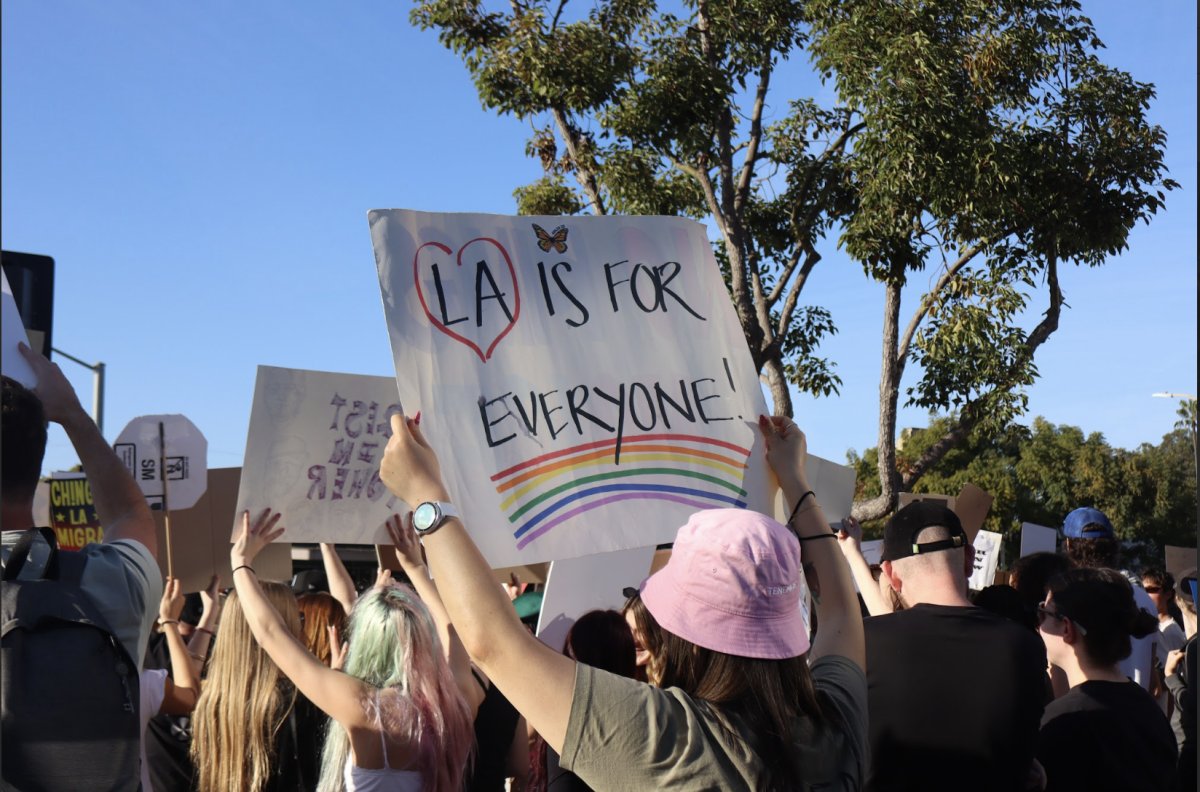
Teachers and staff haven’t been the only ones to take action and respond to increasing immigration enforcement activity. In February, Venice students participated in the school walkouts against ICE.
Senior Marina Aguayo, a student organizer, said students were concerned about “the safety of immigrants in our country.”
As the Trump administration escalated the deportation process, mass immigration enforcement raids began and separated families, confirming Aguayo’s and other students’ anxieties.
“The walkout was about voicing students’ opinions on current political matters,” Aguayo said.
Aguayo expressed the need for clearer communication between the school and its students regarding immigration enforcement policies.
“I want to make sure they make it clear to students when they are safe and acknowledge when they aren’t safe.
“Although L.A.U.S.D.’s response could’ve been greater…The walkout was positive overall…L.A.U.S.D. did see it, and that was the point.”
Another student organizer, senior Gilbert Lopez said, “It helped start a chain of movement.”
“Student movements have the capability to create tangible change, but it isn’t something that will happen after the first try”, said Lopez. “It is something that should be carried on…To keep the movement alive for future students, collaboration with each other is necessary.”
A Historical Context for Current Events
Last year’s walkouts were not the first time L.A.U.S.D. has witnessed student-led protests. In the 1960s, Chicano students mobilized to fight against discrimination within schools.
These protests were known as the East L.A. Walkouts and paved the way for numerous changes within the school system to address systemic inequities. Along with numerous East LA students, the movement included Venice High School students, and this legacy of activism can still be seen through present-day student action.
“Students are the reason why we have these social justice movements,” Social studies teacher Isabel Cortes said. “When they see an injustice, when they’re fired up, when they create a collective to fight and organize, when they create solidarity movements with unions and with educators and with community members and with parents… that is what’s powerful.”
Cortes offers a hopeful outlook for our collective future.
“Resistance and the fight for liberation is still here, and it’s so beautiful- and the world is watching…There are changes happening and we need to keep fighting, because the struggle for liberation, the struggle for peaceful migration, the struggle for human rights; everything is intertwined,” she said.
“Migration is a human process,” said Cortes. “It’s part of who we are.”