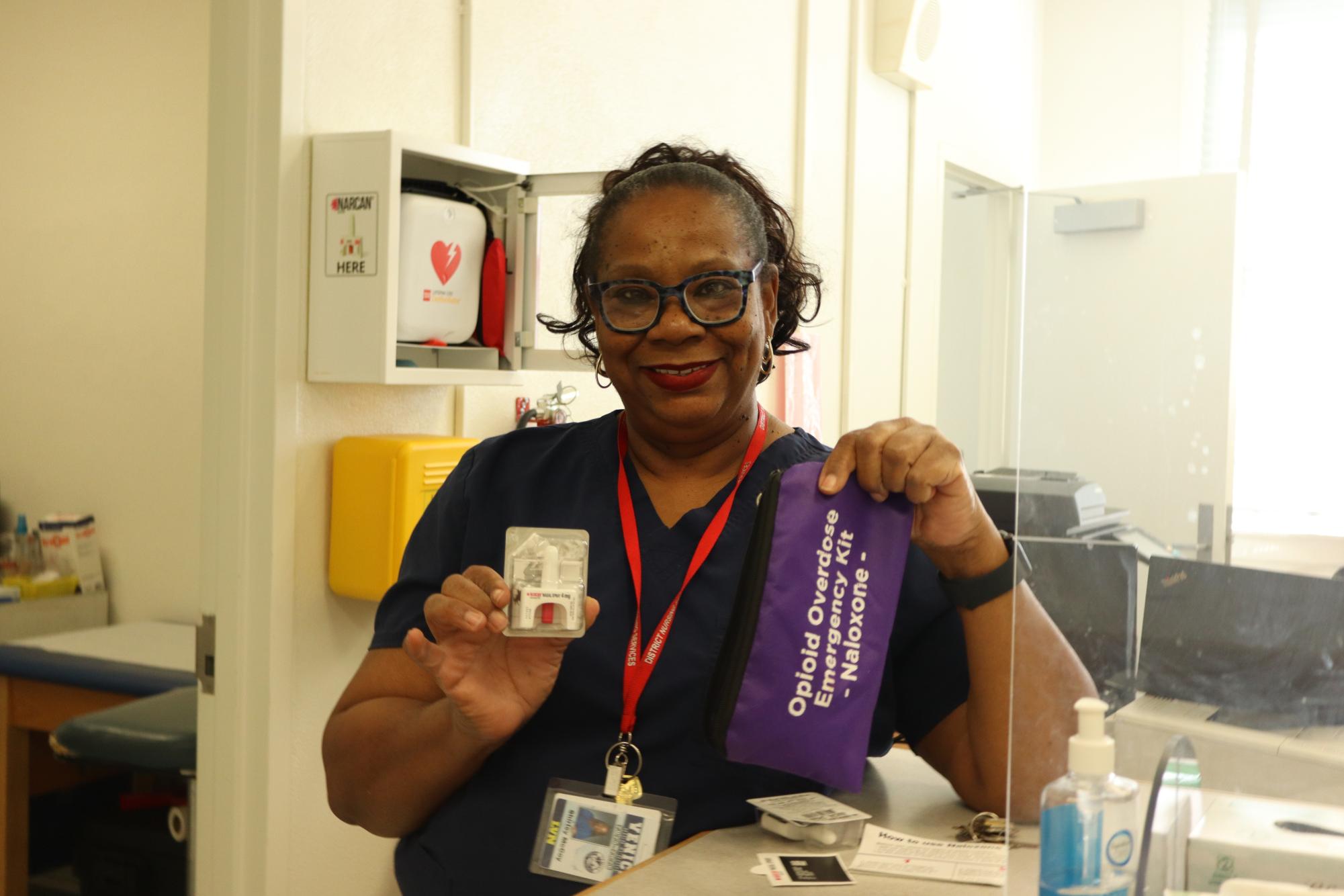
Venice High nurse Jaslyn Taylor led a voluntary staff training on how to administer Narcan, a life-saving nasal spray medication that is used to reverse the effects of an opioid overdose.
Naloxone—the generic name for Narcan—is administered by pushing the nozzle into the nostril and pressing the plunger to release the medication; it requires no setup by the person administering it. Narcan has no harmful effects if used on somebody who is not overdosing on opioids.
This lunchtime training, which took place January 13, happened after two teachers spoke to Nurse Taylor about possibly having a training workshop.
Social studies teacher Taylor Vivanco said that at a professional-development meeting that reviewed other medical emergency procedures, Nurse Taylor mentioned that she was trained on how to administer Narcan.
Vivanco said that this is what brought up the question between him and Spanish teacher Maria Lopez Zamudio of why teachers aren’t trained on how to administer Narcan.
Vivanco talked to Nurse Taylor and she agreed to train teachers if they were interested, so he gathered a group of a little more than ten teachers who wanted to learn how to administer Narcan.
Teachers in California are required to be CPR certified, AED trained, and be trained to recognize some common medical emergencies and be able to administer basic first aid, according to the Commission on Teacher Credentialing. They are not required to be trained on Narcan.
A 2022 LAUSD policy mandates that on every campus Narcan must be available and that there must be staff who are trained on how to administer it.
At Venice High, all of the administration and the nurses are trained on how to administer Narcan. In addition, a total of 23 staff trained on administering Narcan for the 2025-2026 school year (including the teachers who were recently trained).
Vivanco said he feels that this number of teachers is too low.
”It would be great if all teachers were trained on how to use Narcan,” he said. “Narcan is a harmless drug. All it does is it binds to the receptors that opioids bind to and it reverses an overdose, so it’s a really easy way to save someone’s life.”
He noted that Narcan availability does not promote drug use; instead, it just makes sure that there are safety precautions in case somebody does have an opioid-related medical emergency.
“Obviously, I don’t think that students should be doing drugs,” he said. “I just think to be on the safer side, it’s important that people are trained.”
Nurse Taylor thinks that Narcan training should stay optional.
“I don’t want anyone to be forced into a situation, especially when it’s a life or death situation that’s healthcare-related because not everyone is comfortable in that environment,” she said. “When I train people, I want to give them the confidence to do it on their own rather than force someone to do it.”
According to Vivanco, there are three locations equipped with Narcan on campus. He worries that this number is too little and could delay helping somebody in an emergency.
If someone on campus were to overdose, Vivanco said that “every second is going to matter.”
“If I have to wait for the nurse or principal to come, that’s going to cause seconds or minutes that could be spent actually administering the Narcan,” he said. “If I can administer it sooner, I could potentially protect against long-term consequences.”
Nurse Taylor says that she’s willing to train more teachers if they are interested.
”I’m always willing to train staff, whoever’s interested, because it’s so easy to use and it makes such a big impact,” she said.
Though students can’t be trained by Nurse Taylor, students are allowed to carry Narcan on campus.
Both Vivanco and Nurse Taylor hope that teachers and students can continue to become educated on Narcan because it can save a life.