It’s June 2024, and I am 15 years old attending my first summer academy at the California School for the Blind. My new friend Chloe Clemens—who I’ve known for about a day now–runs over to me excitedly and tells me that I should go to the gym and play goalball with her and some others.
“Goalball?” I say to myself. “What’s that?”
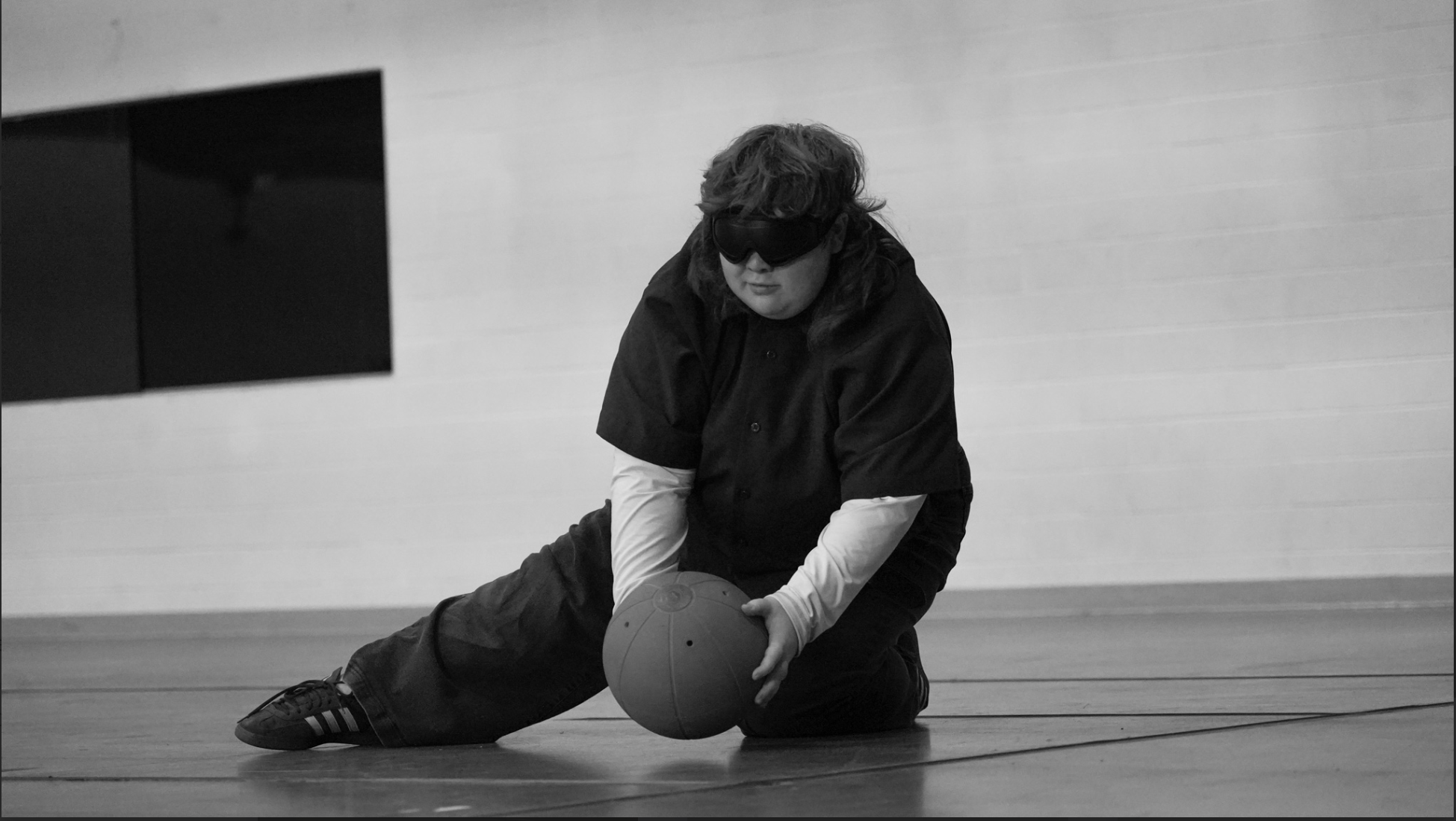
Without knowing what I am getting myself into, I agree. I accompany Chloe to the gym, and I am told to put on a blindfold and get on my hands and knees. I reluctantly comply and suddenly I am in an intense game of dodgeball except I’m on the floor and I can’t see and the ball is 3 pounds and solid like a basketball.
I hated it. I was finally given the opportunity to play a sport that was made accessible to me and I absolutely hated it. I hated not being able to see more than I already couldn’t and I hated the idea of getting hurt by the ball and I hated that there were sighted people who could see me (presumably looking stupid).
After that first experience playing goalball, I decided to do some research on the sport and I ended up learning a lot.
I learned that goalball is a sport for blind and visually impaired athletes where two teams of three players work to defend their team’s goal and roll the ball into the other team’s goal.
For the unfamiliar: here are the basics.
To defend the goal: players move from their starting position—typically on hands and knees, sometimes with one foot planted on the ground—by diving onto their side with their arms above their heads. They need to effectively use the length of their bodies to block the ball from reaching the net.
To roll the ball: upon blocking the ball or being passed the ball, players will rise from their starting position and—before 10 seconds have been reached since first contact with the ball, to avoid a penalty—roll the ball across the floor. They need to make sure it makes contact with the ground before reaching the high ball line to avoid another penalty.
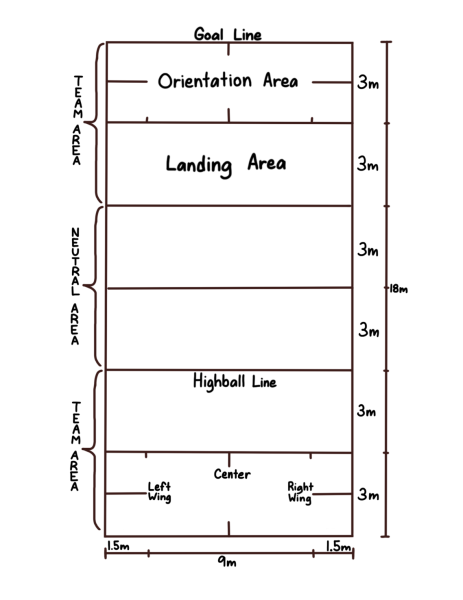
A goalball court is 9 by 18 meters (equivalent to 29 ½ feet by 59 feet) and is separated into 6 sections of 3 meters each.
The lines of the court are made tactile by layering tape over string, ensuring that players can locate where they are on the court without vision. While playing, players wear eyeshades that block any vision they have so that all players are on an even playing field. This also allows sighted people to play the sport alongside blind and visually impaired people.
The more I learned about the sport, the more I wanted to try it again but unfortunately, goalball isn’t the kind of sport that you can play spontaneously. You need a tactile court, a ball with bells, an eyeshade, knee and elbow pads, a whistle, and a lot of other people—including at least one sighted person to be the referee.
I wouldn’t get my next chance to play until this past summer when I was back at the California School for the Blind attending another summer academy, Camp Abilities. Camp Abilities is a sports camp for blind, visually impaired, and deafblind youth that has programs across the globe.
This time I promised myself that I would be the best goalball player I could be and learn as much as I could without giving up due to embarrassment or fear of failure. With Chloe at my side, I did just that. The whole day we played goalball, throwing the ball as hard as I could to score goals and slamming my body into the floor to block the ball, even if it meant blocking the ball with my face.
I remember Camp Abilities and playing goalball there very fondly and Chloe said that she does too.
“I got to play with people that I knew and we were all having fun and learning,” she said.
Since Camp Abilities, I’ve played goalball every chance I can—which has only been twice so far. I found a local organization in Los Angeles called Wayfinder Family Services that facilitates goalball and I’ve been attending their open practices.
Daisy Rosales, who is program coordinator for Wayfinder Family Services, says that the work she does facilitating adaptive sports is impactful to her because she gets to see the players she works with branch out.
Rosales is also a player herself and has been playing for around 19 years.
“My introduction was when I was around six or seven years old,” she said. “I used to go to Wayfinder back when it was called Junior Blind of America and they had an event called the Junior Blind Olympics. I participated in the goalball games that they had there in order to try and win a medal and I fell in love with it from there.”
She currently plays for a team called the Phoenixes, which is one of the teams based at Wayfinder.
“It’s really enjoyable getting to see the camaraderie that comes from being a part of a team playing against other people,” she told me. “It’s one big old happy family group and you get to learn and grow as long as you go and as long as you are committed to doing that.”
Rosales says that playing goalball has had a lasting impact on her life both on and off the court.
“It’s really helped me learn a lot more about myself and how much I feel confident in not having sight,” she said. “It’s helped me outside in my daily life of understanding that I will go blind one day but because of goalball I’ve been able to adjust to being blind and I’m okay with that.
When playing goalball at Wayfinder, I also met and played with a lot of other players including Alan Pineda. He played left-wing and I played center in a match that we ended up winning together.
Pineda said that before playing goalball, he didn’t think of himself as very athletic and thought of himself as a more nerdy and creative type of person.
“Goalball has definitely made me think twice about sports,” he said. “It’s made me realize that when something is adapted and it’s done well, I guess I do like sports. I guess it’s changed my mind on the way that I think about my own identity, of how athletic I can be, and just sports overall.”
Pineda says that his favorite part of playing goalball is the community aspect.
“My favorite part of goalball is definitely being a part of my team and getting along with people who are also visually impaired,” Pineda said.
Another Wayfinder player, Jennifer Vasquez, echoed a similar statement.
“It gives me the opportunity to be able to socialize and also to be able to have team spirit,” she said. “Whether you win or lose, I’ve felt it’s a good experience.”
Vasquez said that she tried many adaptive sports including blind soccer, beep baseball, and judo but ultimately found that she enjoyed goalball the most.
“Out of everything I’ve tried, I can say goalball is the one I really feel I am more on the same level with everybody else,” she said.
Rosales, Pineda, and Vasquez all play competitively in tournaments. Rosales told me that goalball tournaments give players the opportunity to get out in the world and network.
“The more that people are wanting to travel and get better, the higher that they get,” she said. “The highest you can get is the U.S. Association of Blind Athletes and the Paralympics.”
Tre’Shaun Faison, a Paralympian who played goalball in the Paris 2024 games, told me that to get to the Paralympics, he had to play in tournaments and build up his career.
He started playing goalball at the Florida School for the Deaf and the Blind.
“I was 14 and in high school—I believe my 9th grade year—and it was actually bad,” he told me, recounting his first experience with goalball.
Despite not making the team the first time that he tried out, he continued to work at goalball and did well in high school. After that, he went on to play tournaments and work his way up.
“I played a lot of domestic tournaments,” Faison said. “I did that after a lot of practice and being pretty good in the high school team.”
“It’s the only thing where I don’t get penalized for not being able to see as well,” Faison said when asked what made him want to play goalball professionally. “I’m pretty athletic but with basketball or football, things were hard because you can’t see no matter how athletic you are, but with goalball it evens the playing field so I just saw beauty in that.”
Faison also said that goalball keeps him accountable.
“I can’t make any excuses, I really like that part,” he said. “If someone’s better than me, it’s not like ‘Oh, I can’t see so that’s why that happened.’ There’s no excuses so it makes you keep yourself accountable.”
Faison said that playing in the Paralympics was surreal and almost inexplicable.
”When you’re there, there’s thousands of people watching you either cheering you on or booing you out of the gym,” he said. “It’s pretty surreal but it’s really cool being able to support your team and represent Team U.S.A. when you walk out.”
It took him a lot of practice, time, and sacrifice to get to the Paralympics.
“I spent about two-and-a-half years before I went to Paris in the middle of nowhere—in Fort Wayne, Indiana—in the miserable cold practicing day in and day out,” he said. “A lot of times it seems like a thankless job because you don’t get a lot of recognition.”
Faison said he plans to continue in the Paralympics.
“I’m training here at the Olympic training center right now, hoping to go to LA 2028,” he said.
The thing that stands out most about goalball is that it’s the only sport that’s made specifically for blind and visually impaired people.
“The thing about goalball is that every other blind sport is adapted from something else—blind soccer is from soccer, beep baseball is from baseball, but goalball is its own thing.” Faison said.
Similarly to Faison, Chloe said, “Goalball is different from any other sports. There’s sports that you can compare it to but it’s its own thing, it’s its own sport.”
Pineda noted that goalball has a lot of traits from various other sports.
“It’s really weird and interesting because it’s like a combination of so many other sports,” he said. “It’s like a mix of dodgeball and soccer in a way and a little bit of bowling so it’s just like all the components of other sports made their way into goalball.”
Rosales said that, “Goalball is important because it’s the only sport out there that’s meant just for the blind. Everybody can participate whether they’re sighted or not but at the end of the day, it was a sport for us created by us.”
Goalball has truly changed my life for the better in so many ways. Goalball is what inspires me to improve myself and to work harder and it’s what has given me the opportunity to participate in sports, which is something I’ve never been able to do before.
I, and everybody I interviewed, encourage you to try goalball, especially before making judgements or assumptions about it. “It’s a lot harder than it looks,” Faison noted.
Rosales also encourages you to volunteer with goalball organizations. Goalball cannot be played without the help of sighted volunteers and referees.
“Any time you’re looking to make an impact, it’s as easy as going online and seeing where you can go volunteer and what you can do for your community and other communities, so if you’re ever looking for something to do in your spare time, just come out, come play, and come help out,” she says. “There’s always something for you to do.”
If you’re blind or visually impaired and looking to get into sports, I highly recommend trying goalball.
Chloe says, “Don’t be afraid of goalball. It sounds scary, but it’s not scary.”
Faison also said, “If you have a blind friend that’s scared to do sports because of their vision, try to motivate them to at least go try goalball.”
If Chloe hadn’t pushed me to try goalball last summer, I don’t know if I would have ever played it and found this sport that I love so much, so listen to Tre’shaun Faison and encourage your friends to try goalball!