


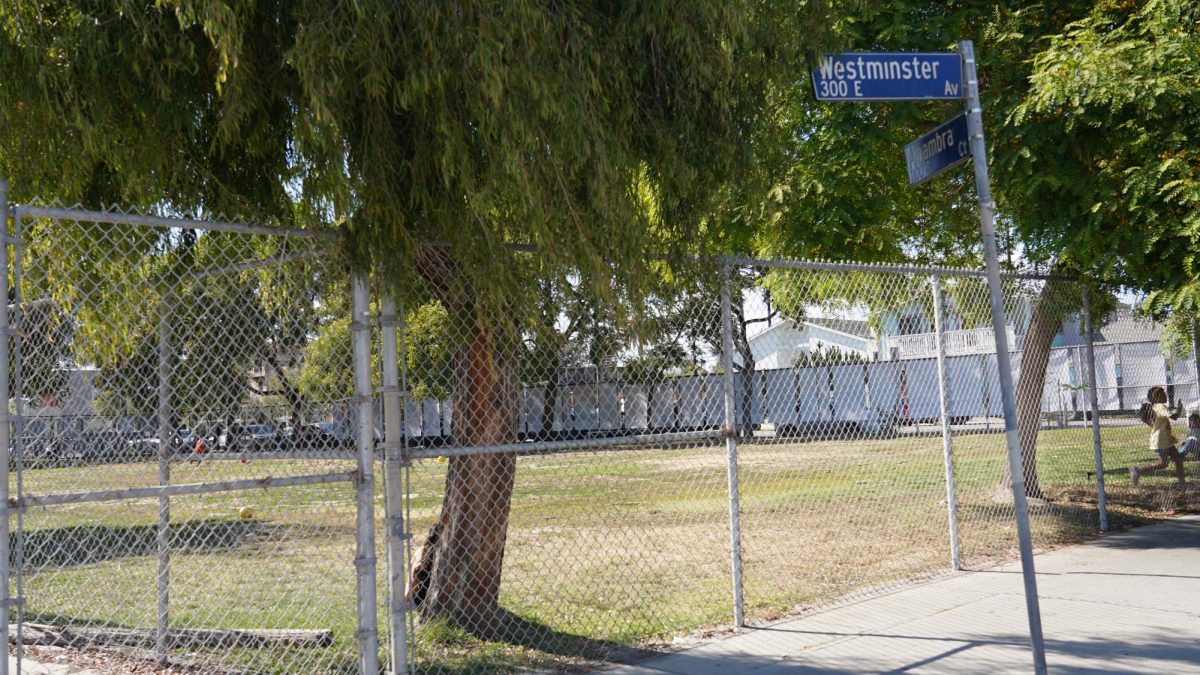
Since its establishment in 1892, Lincoln Park has been an unassuming part of Santa Monica. It’s now known as Christine Emerson Reed Park. Still, its original name lives on, thanks to one of the most famous nu-metal groups in the world.
Three Agoura High School students formed what would become Linkin Park in 1996. Like its namesake, the band experienced significant upheaval over the next few decades– but its identity remains unchanged.
Linkin Park’s angsty rap-rock experienced a meteoric rise in popularity, appearing in 2000s cultural lodestones like the Twilight and Transformers films. For a while, they were among the most successful rock bands in the world. No one expected their lead singer, Chester Bennington, to take his own life in 2017.
The band went on a hiatus and returned in 2024 with a new singer, Emily Armstrong of Dead Sara. Her entrance was marked by controversy and skepticism, but that didn’t stop Linkin Park from taking over the globe again.
Last year’s album From Zero, Armstrong’s debut, was the definition of a comeback. Its success quickly led to a world tour.
On September 13, the From Zero World Tour went back to Los Angeles, this time at the Intuit Dome. The opening act was the experimental rapper JPEGMAFIA. Although entering the venue was less than intuitive, the show was a good outlet for that aggravation.
The opener was intriguing, but the sound quality was too bad for it to transcend intrigue. JPEGMAFIA was far more animated than the audience, lightly mocking them through an autotuned “Call Me Maybe” cover before launching into another song.
However, there is only so much an artist can do with a lukewarm crowd and bass loud enough to drown out all his words. From my seat in the nosebleeds, his set was a faraway man in blood-red lighting trying to rap over the sound of a foghorn for half an hour.
After a 10-minute countdown, the main act took the stage. What ensued was a two-hour demonstration of why Linkin Park isn’t struggling to stay relevant. It was an impressive show, to put it mildly.
The setlist had obvious crowd-pleasers from Linkin Park’s past, but also included slightly deeper cuts and songs from the latest album. Two songs by Fort Minor (vocalist Mike Shinoda’s side project) were also played. This was obviously self-indulgent on Shinoda’s part, but still fun. Longtime member Joe Hahn also got a moment in the spotlight with a turntable solo.
Linkin Park’s recent song “Unshatter” also made its live debut at the Intuit Dome. The song isn’t especially experimental, but it makes good use of the band’s distinctive back-and-forth between rapping and singing. It makes sense that they would debut it in their hometown. Almost every significant Linkin Park show, including the ones bookending their hiatus, has happened in Los Angeles.
During a brief interlude in which he gave a fan his hat, Shinoda also rapped part of the underrated song “High Voltage,” which was incredibly gratifying. Throughout the show, his energy was infectious.
Of course, one cannot praise Mike Shinoda without addressing the other half of Linkin Park’s vocals. Chester Bennington’s voice was distinctive. He could scream for a confounding amount of time and immediately go back to normal singing, without going off-key or losing any of that visceral emotion.
Many people I mentioned the concert to said that Emily Armstrong couldn’t express as much anguish, and she “just wasn’t as good.” This is understandable. Bennington’s voice meant a lot to people, and no one can truly replace him. He had a unique aptitude for conveying pain.
But after hearing Armstrong live, I think this criticism misses the mark. There is no shortage of feeling in her voice, which was made especially evident when she sang “IGYEIH” and “Lost.” The album versions of her Linkin Park and Dead Sara songs are also prime examples of this.
Rather than imitating Bennington, Armstrong stayed true to her own style to deliver a seemingly superhuman performance. I’d seen footage of her live performances, but this one surpassed them in vigor and aggression. She and Shinoda were a natural team.
At many different points in the show, I had to stop attempting to sing along with her guttural screams or risk losing my voice. When she did a 15-second scream during the From Zero song “Heavy is the Crown,” the crowd went appropriately wild.
The show’s sound quality was thankfully far better than that of the opening act. Lights throughout the arena were perfectly synchronized with the drums, guitar, or vocals. I’m inclined to criticize the amount of strobing, but it was otherwise a cool experience.
The screens over the stage alternated between showing abstract visuals and live footage, with editing that changed depending on the songs. The visual effects often referenced the songs’ music videos.
The most affecting visual moment was near the end of “The Catalyst,” which already had eerily relevant lyrics. The technicolor lights and footage of the band, the haunting music, and the galaxy of audience members’ phone lights made for a surreal two minutes.
One would expect Linkin Park to gradually fade into relative obscurity, like the rap-rock groups of years past. But the passage of time, society’s progression past the genre, and the passing of their lead singer couldn’t make that happen.
Part of this is due to Linkin Park’s focus on negative emotions in their music. When Chester Bennington screamed about his alienation, his listeners felt understood. The world has changed drastically since the 2000s, but unhappiness is a universal constant.
At the concert, I saw parents who had taken their children to experience the same music that had shaped their youth, and excited teens whose families had grudgingly gone with them. (I was in the latter category.) The band’s return clearly sparked nostalgia for many people.
However, that nostalgia isn’t always a positive thing. It’s stopped some fans from giving Linkin Park’s new music a chance, just because the band has moved on and is still making new music. Despite Linkin Park’s past support of alternative hip-hop, about half the audience at the concert likely skipped the opening act because they didn’t know who JPEGMAFIA was. I nearly did the same.
Linkin Park exists in conversation with its past and future. They’re not trying to bring back Bennington or try a completely new style; rather, they’re synthesizing their best qualities with new talent. And through it all, they’ve reached out to their fanbase (occasionally by giving them hats).
At the concert, Shinoda dedicated Linkin Park’s signature song “In The End” to Chester Bennington’s family, who were in the audience. When the first few notes played, the stadium glowed orange and the audience screamed in unison.
In my view, this is why Linkin Park is timeless. Twenty-nine years after their inception, they still offer people catharsis and connection through their music. Ironically, songs about isolation allow millions of people to be part of something.
Lynn • Oct 11, 2025 at 1:46 AM
What a great review. I’m a day one Linkin Park fan, and attending this show was a blessing that I’ve waited for a long time to see. I was devastated that I never got to see Chester live. That being said, I was very skeptical when I first heard Emily Armstrong. I listened to everything I could to get a feel for her. Still I wasn’t sure. Hearing her live was an eye-opening experience. She has a soul-shattering style and a scream that is her own, all the while respecting Chester’s presence on the stage. I love that Mike is more in the forefront now, and I feel like Brad and Joe and the rest of the band are featured more. I’m grateful that they have remained true to themselves, and I will remain a fan forever.
Sbannon kenyon • Oct 10, 2025 at 2:41 PM
Awesome