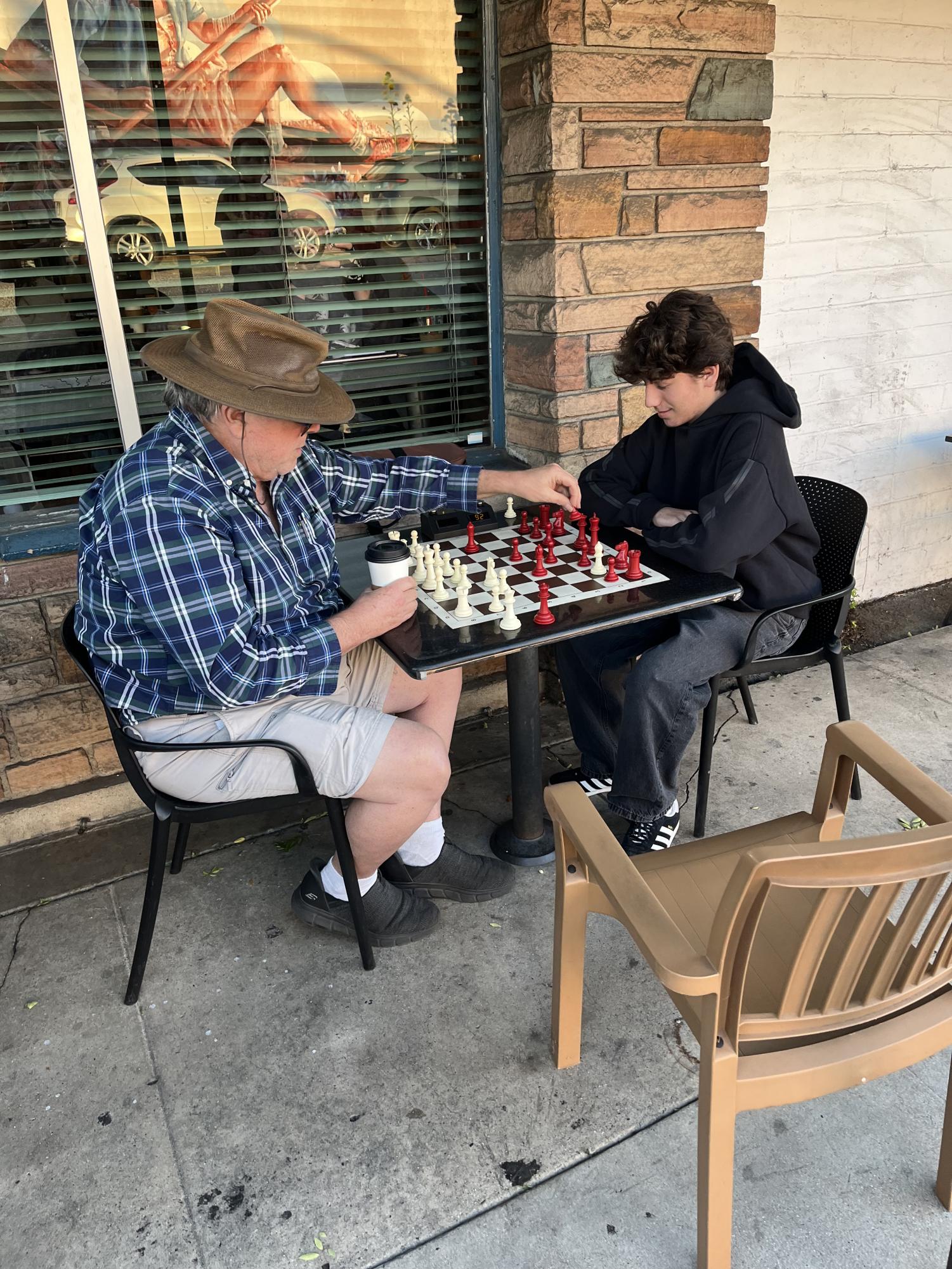
A fun fact about chess is that there are more possible chess games than there are atoms in our universe.
This is called the Shannon number; it’s an estimate of the total number of possible unique games of chess. This number is roughly 10120 while the total number of atoms in our universe is 1080. Since there is practically an infinite number of possible games, it’s impossible for chess to be boring because there are always new positions that can occur.
Carl Hyne—or more known as the Great Carlini—is a notorious street chess player and chess hustler. Chess hustlers are energetic characters who set up in tourist-heavy locations and play money-stakes blitz games (blitz means each player has three to five minutes for the entire game) usually involving banter and trash talk. Carlini is not your average chess hustler however as he also serves as the face of “Coffee Chess,” a popular Youtube channel that features games played with strong players and celebrities in the chess world.
The Great Carlini used to hustle tourists at the Santa Monica Pier as he would “bark at them” to play chess with the Great Carlini. This worked quite well because of his personality, which attracted many towards him.
People who played him would pay for an experience and go home with a story. But then COVID-19 came, dropping the number of tourists significantly. Carlini’s sister taught him how to play chess back in the 1970s, meaning that he’s been playing chess now for over five decades. He’s never lost interest in chess and continues to play everyday at a multitude of locations around Los Angeles.
There’s a lot of psychological aspects of chess, The Great Carlini says.
“How you present yourself on the board is almost as important [as your actual skill level]—especially psychologically,” he says. The body language and / or nervous ticks players have show their confidence, and is therefore psychological.
For instance: let’s say you are playing a game and you take a minute to make a move and then your opponent makes their move instantly after you do. This then makes you think twice about whether you possibly made a mistake that they saw or if they’re just bluffing.
I play chess online frequently and it’s quite different than playing in person. Chess in person only has this psychological aspect, while chess online doesn’t because you are just facing a screen. This ties back to Carlini in that he’s very good at playing psychological chess because he’s always very confident which can discourage his opponent, even if he is in a completely losing position.
The Great Carlini has played against many famous people in the chess world including influencers like Andrea Botez and Nemo Zhou. But his most memorable game was against the second best player in the world, Hikaru Nakamura (to make the game fair, Carlini had five minutes while Hikaru had one minute). At one point during the game, Carlini had a move that would have given him a big advantage, but unfortunately it was not played, leading to Hikaru’s victory.
When I played the Great Carlini, I was nervous at first because I was worried that he would destroy me with ease. But as we played, I utilized an opening known as the Scotch game, immediately striking in the center and aiming to undermine the Great Carlini’s e5 pawn.
Soon, we got into a position that I was very familiar with and, because of that, I actually ended up in a slightly winning position throughout the opening phase of the game. Just because I had the slight edge, however, did not mean Carlini didn’t have any tricks, nor did it mean the position would be easy to convert.
As we approached the mid game, Carlini strategically and methodically dismembered my position and established himself a winning position, his comfortability on the board reflecting in real life. Oozing with confidence, Carlini played fast and loose, creating the impression every move he played was the best and most accurate.
Carlini’s impact on the Chess World extends much farther than just hustling park goers. The Great Carlini continues to inspire a multitude of players from all different backgrounds, helping to grow the game he loves while bringing all sorts of people from around the world to play chess in LA.