Ironically, children’s books are some of the most profound and impactful pieces of literature.
Children’s books are most conventionally made to attract kids’ attention with wholesome illustrations and positive language, but almost all allude discreetly to the real world repercussions of behaving in ways that deviate from the story’s intended message.
While this is deliberate, children often miss the implicit undertones that could even be discouraging to them, swallowing only the buzzwords on the surface and absorbing the manifestations of the author. Maybe this is their purpose; to shield children from harsh realities and redirect them to safety.
Recently, I’ve reread a collection of favorites, and suddenly the nuances of my identity start to make sense.
Stellaluna by Janell Cannon first introduced me to the importance of bridging differences, but also protecting the foundation of those differences in order to grasp the importance of your singular identity.
The Giving Tree by Shel Silverstein nurtured the mini environmentalist in me, but also showed me the complex and selfless permanence of nature, the constantly self-sacrificing resources it offers, and the unconditional silent forgiveness that remains as we become distracted by the dilemmas of maturing.
The Story of Ferdinand by Munro Leaf showed me that strength and determination is not shown through aggressive involvement or a toxic performance. Rather, it is much more powerful when you find the beauty in “smelling the flowers” and pursuing self-fulfillment through the art of being unapologetically gentle. I am a mosaic of these themes.
Meanwhile, the books read by teachers at pre-school and elementary levels taught some form of constructive discipline. No, David! By David Shannon has been famously read by teachers to students to show the effects of behaving inappropriately and immaturely, but in a very humanizing empathetic manner.
The book ends with that reassuring note of “Yes David, I love you,” despite the mom’s fury with David’s behavior throughout the book. I always saw my teacher flash looks at the “trouble child” during storytime, perhaps hoping to alter something in their brain chemistry for the better, but possibly coming across as condescension and unintentionally instilling more rebellion in them.
These are the stories that stick with you as you age. Each one takes time to fully reveal itself, and as you get older you uncover the message as a whole — an amazing process. Considering the ways that I am constructed by books, I find myself wondering how children’s books might behave as a variable in our personalities.
By the time you are three, you have already mastered the skill of exhausting your parents with relentless questions in the form of telegraphic jargon. Whatever information you come across, true or false, you grab onto with mysteriously sticky hands; you learn rapidly, but you are subjected to mounds of misinformation.
Correct and incorrect information is taken in as the same information by young children. With this, it is important to be taught a net positive of good, useful information. Picture books become a resourceful way of gradually teaching children to read and write, but also to gain emotional awareness.
Parents usually start reading books to children just as they begin developing their “Theory of Mind,” or their capacity to recognize others as having thoughts or feelings that are different from their own. Studies suggest that the act of narrating a children’s book may help the child attribute mental states to the characters within it.
By introducing children to different points of view, you are increasing their capacity to feel empathy, as well as fostering moral development. This is intriguing for a variety of reasons, but a few main inquiries surface: Could not reading books in your childhood lead towards apathetic tendencies later in life? Is there such a thing as “reading the wrong books,” or “learning the wrong messages?”
Something that comes to mind is the indoctrination of children in Germany during the Third Reich. The book Der Giftpilz depicts Jewish people as poisonous mushrooms, “[alluding] to how, just as it is difficult to tell a poisonous mushroom from an edible mushroom, it is difficult to tell a Jew apart from a Gentile,” the Wiener Holocaust Library adds in the description.
In this case, German children were being educated with Nazi propaganda as their Theory of Mind developed, meaning they learned how to attach incorrect emotional traits to Jewish people – but they didn’t know it was wrong. I’m sure that being implanted with antisemitism at such a developmental stage internalized within many.
Children are impressionable, and books certainly influence them, whether the opinions they carry are more subconscious or not.
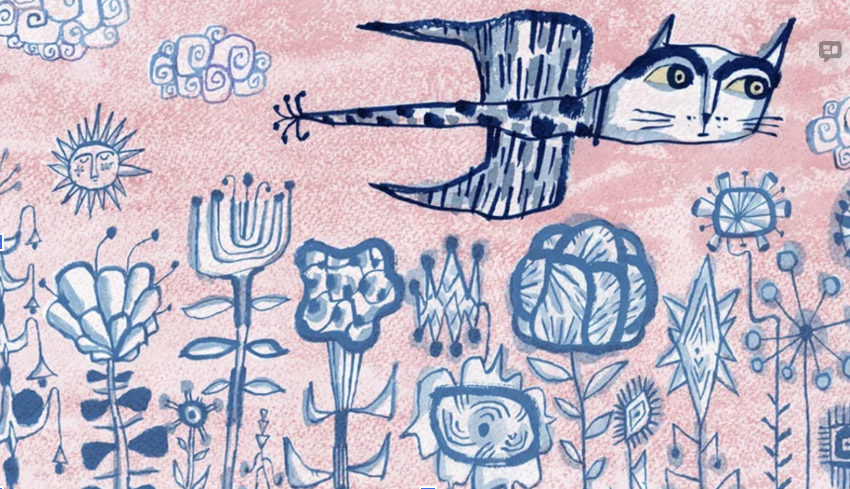
Children’s book author/illustrator Calef Brown is one of the artists of my early childhood. His artwork is vivid in my mind– surreal, geometric, colorful, and somewhat abstract. I find it interesting that I am incredibly partial to this style now.
“I think that for me, you know, it’s really tied to imagination, and larger forces in my life.” Brown said.
Brown explained that when he was young, he had a strong taste for Dr. Seuss books, specifically Sleep Book and The Grinch. He was also very keen towards the This is… series by the Czech writer and illustrator Miroslav Šašek.
After looking him up, I immediately noticed the uncanny resemblance between Šašek and Brown’s art style. These were shapes and colors I was familiar with.
“You can see the direct connection between my style and these books that were imprinted on me, like second, third grade. But you know, it was in no way a conscious awareness that my work should be this way in order to connect with kids,” Brown noted.
The books that Brown read appealed to him in their quantity of imagination and creativity. Meanwhile, that was exactly what Brown’s books provided for me at 5 years old. We have both grown to create art and appreciate its strange nuances.
Brown began to tell me the meanings behind his poems, and how quite a few of them have local significance. For example, Highwire 66 is about being stuck in traffic on the LA highways, and Snails is about Brown’s Venice home and the invasive “pesty snails” that he bargained with his landlord to keep around. Circling back to an earlier statement, I realize that I never fully understood Brown’s poems until I reached this age.
When asked about what impression he hopes his books can leave children, he said “I would hope that it would foster a curiosity, a love of language, language as music, language as something that’s playful.”
Brown said he wonders as well if children consciously pick up messages, “because kids are so smart, whether they see that, and are like ‘Okay, I get the message!’”
In a sense, I believe children are oppressed. Oftentimes, their questions are met with condescension, and they have so many. They are in no way treated as equal, and are made fun of when they make mistakes as well as when they get things right, because it’s hilarious having big thoughts come from such a little head. Have we ever read any Roald Dahl?
Each human may have inherited defiance and rebellion because of having experienced these conditions at such a developmental age. We grow, and there’s always an inward struggle and an outward attempt from each of us. Everybody has tried to change something at least once. Nobody will ever be fully satisfied, it’s pretty great.
Somebody will always have the upper hand, and this time it isn’t schoolteachers or parents or your piano teacher. It’s not the Grinch or the Wicked Witch of the West. Peter Pan set the false expectation of being whisked away to Neverland, where Lost Boys are set free of all reality and their oppressors — and even there, Captain Hook is trying to kill Pan constantly. We cannot escape the fight-or-flight of the “bad guy archetype,” so when are we supposed to fight?
I think that if every single person in the world were to put down everything and read Shel Silverstein, the world might become more habitable. I’ll spare you the names, but perhaps the most significant adults today lack the social and emotional understanding that should have been introduced to them through picture books.
Your mother-tongue is Mother Goose. So is theirs. And even theirs. As long as you have brains in your head and feet in your shoes, Oh, the Places You’ll Go!
“Listen to the MUSTN’TS, child, Listen to the DON’TS / Listen to the SHOULDN’TS, The IMPOSSIBLES, the WON’TS / Listen to the NEVER HAVES, Then listen close to me—/ Anything can happen, child, ANYTHING can be.” — Shel Silverstein