The ground rumbles and shakes beneath you. Walls around you crumble; your roof collapses. Both panic and realization set in simultaneously.
You’ve felt an earthquake before, but not one like this—not one capable of toppling buildings and decimating the L.A. area.
This is the reality of an unimaginable and catastrophic earthquake, one bound to strike California.
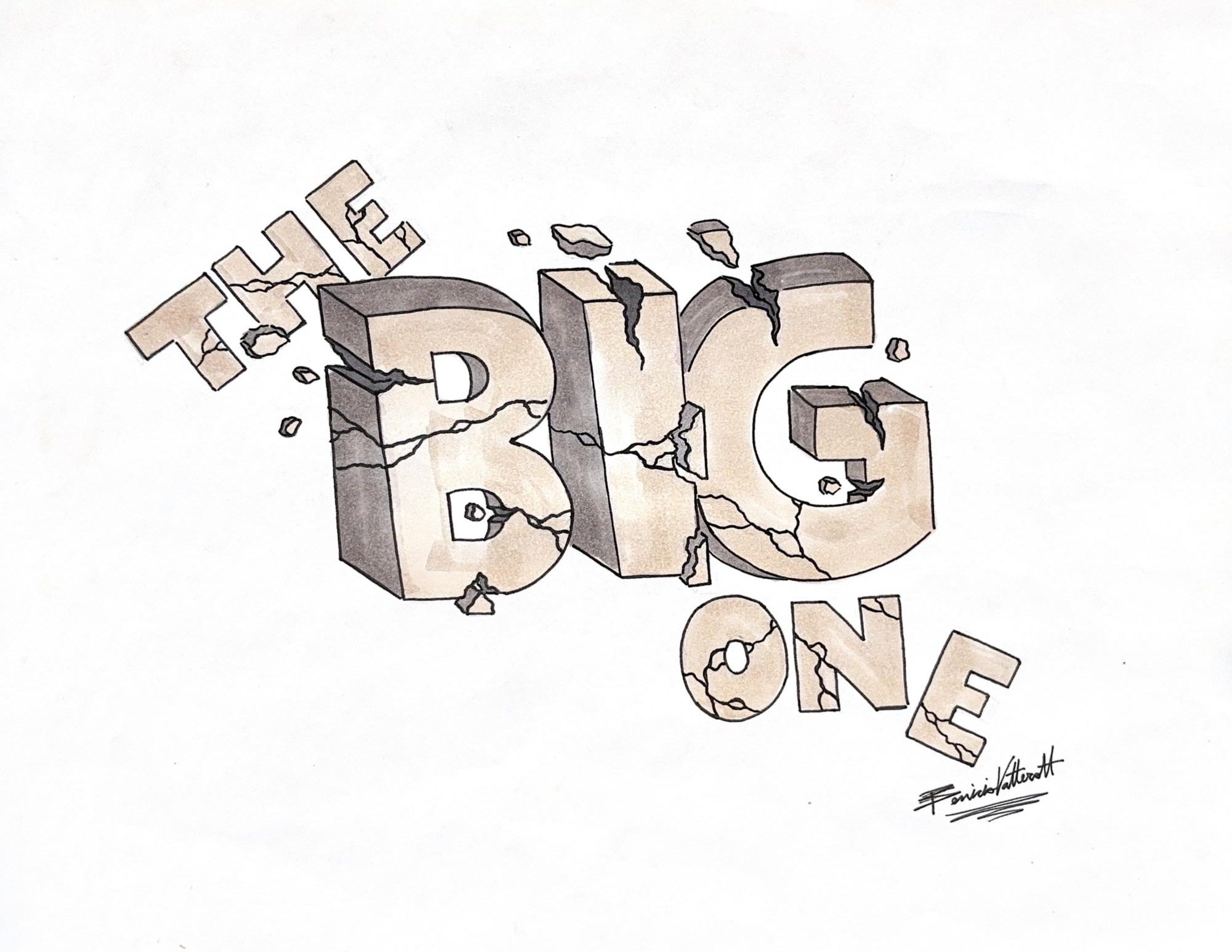
Known colloquially as “The Big One,” this earthquake refers to an earthquake that would occur along the North American tectonic plate and the Pacific plate, creating the San Andreas fault line that spans 800 miles. This event would be devastating, especially to the L.A. area—and it would not only cause massive structural damage, but also start fires and trigger a potential tsunami. An earthquake along the San Andreas fault line is predicted to be a magnitude of 7.8.
The strength of an earthquake is measured by the moment magnitude scale. The moment magnitude scale is on a logarithmic scale, and each magnitude higher represents 10 times more wave amplitude and 32 times more energy released.
This means that going from a magnitude 3 earthquake to a magnitude 7 earthquake, the magnitude 7 earthquake results in 10,000 times more ground movement and 1,048,576 times more energy released.
It’s also important to know that the Earth’s crust is made up of tectonic plates that are constantly in motion, with small changes moving around 1-20 cm a year. An earthquake occurs when these plates are forced into each other, build up friction, and suddenly slip. Because earthquakes occur along the sections between tectonic plates (also called fault lines), we can know where earthquakes will hit.
But how do we know when “The Big One” will happen?
Earthquakes are extremely difficult to predict, but we do have long-term prediction methods, particularly as they occur along fault lines. Simply studying where and when earthquakes have occurred can give us an idea of when another might hit.
Other warning systems only manage to detect seismic motion as soon as an earthquake begins. When an earthquake hits, less destructive but faster seismic waves called P waves radiate out of the epicenter; these first waves are detected, and the strength and epicenter of the earthquake can be calculated for a warning to be sent out.
This lack of advanced warnings for earthquakes enhances our need for preparation for an event like this, as these warnings may only give seconds of forewarning.
Addressing a Crisis
Assistant principal Melissa Shelton, who oversees Venice High’s safety, says that the best way we can prepare for an earthquake is to practice for one. The most popular procedure is California’s Great Shake Out.
The Great Shake Out is an annual earthquake drill performed in California to help teach students and staff how to act in case an earthquake strikes.
“The goal of the Great Shake is to assimilate as much as possible the idea of a catastrophic earthquake,” says. Shelton.
The procedure of the Great Shake Out is more than students walking onto the field. Teachers and staff have to go through certain scenarios behind the scenes to ensure that when “The Big One” hits, staff are prepared .
“Our approach to planning for it is integrated within our integrated safe school plan, which has different staff members who are assigned to different roles,” Shelton says.
During the Great Shake Out, teachers and staff are responsible for creating search and rescue teams and a trauma station, as well as a reunion and request gate and accommodations for disabled students, according to Shelton.
LASPD Sergeant Abbe Redin says that if an earthquake were to occur while on campus, their main priority would be “scene containment.”
“If there are power lines down or cars blocking the road, we want to make sure we have clear access to our schools to let fire rescue get in and out to provide the first aid some of our student faculty are going to need,” he says.
In regard to drills like the Great Shake Out, the role of school police is also important.
“We give an assessment on how well the staff is doing the drills and preparing the students and faculty to address the situation, but also working laterally to try and find ways for us to be better in our response,” said Sergeant Redin. “We are very confident that we will be able to provide the necessary assistance to our schools that are affected if a devastating earthquake were to ever happen.”
Shelton says it’s important to reflect on drills like the Great Shake Out.
“After every drill, we reflect on how both the students and staff perform and check if we have met all our benchmarks,” she says. “This time was even better than the first evacuation drill.”
One major change that Shelton mentions was that we now always meet with our advisory period.
“It makes more sense instead of you having to come with just your class and that class having a designated spot, because then if it happened during a different period, you’d have another spot.”
This shift towards advisory keeps the drill consistent with an earthquake that could strike at any time.
“We know at the end of the day there will be human nature and response to a natural disaster, but the purpose of having the drills, and the California Great Shake in particular, is that we are in an earthquake zone and it could happen at any time,” Shelton says. “And even though our tendency is to respond maybe one way as humans, the purpose of these drills is to have that unconscious behavior like muscle memory.”
Student and Staff Perspectives
Junior Dimitri Portilla says he doesn’t feel ready at all.
“If there was a really dangerous one that could cause structural damage, I probably wouldn’t know what to do,” Portilla says.
Senior Boots Lester echoed these statements.
“I don’t know what I’m preparing for,” he says.
Senior Frankie Amico is confident in California’s infrastructure and preparation.
“I think that California and California construction especially has been prepared and implemented enough that we can handle large earthquakes.” Amico says
History teacher Leonard Beckerman says that he feels “prepared.”
“I think that we’re taking the proper channels of evacuating students and making sure that students are safe within the classroom,” he says. “As of today, we’re the best we can possibly be prepared.”
Ms. Jones, beloved school faculty and campus aid, offered a final word of warning to students and staff: “It’s coming and it’s gonna be huge,” says Jones.
“Everybody has to be focused and ready to go,” she says. “It’s not a joke.”