“Many architects are less concerned with what I might say as the artistic expression of architecture,” says Andrew Galambos, my friend Zane’s dad, who also happens to be an architect.
That was not the case with Frank Gehry, a Los Angeles-based architect who passed away on December 5, 2025. He looked for a deeper meaning.
Earlier this month, I embarked on an architectural journey with Andrew and Zane to become knowledgeable on Gehry.
Right when I got to their house and saw Andrew flipping through pages of architectural guide books in his kitchen, I knew that he would be the perfect Gehry-loving architect to take me on this tour.
When we got in the car, a post-it note stuck to the center console had a list of the names and addresses of Gehry’s works we would be going to in Venice and Santa Monica.
Within the first 15 minutes of our tour, I realized through Andrew’s flowing architectural thoughts that he actually worked alongside Gehry for four years at the Gehry Partners Firm—something I was not aware of before we started our drive.
“Gehry didn’t really talk to people that much,” Andrew says.
According to Andrew, the office was a big open space, but Gehry was one of the only ones who had his own office space within the building. The sliding doors of his office faced all the other people in the open area.
“Partly because he is kind of like the star architect,” says Andrew.
Andrew told me that Gehry used to sketch a lot but also had an interest in sailing, which you can see influenced his design. He used a lot of curves in some of his more recent works such as the Walt Disney Concert Hall.
“If you look at the Walt Disney Concert hall and start to think about how a sail looked, you can see that there’s a relationship,” says Andrew.
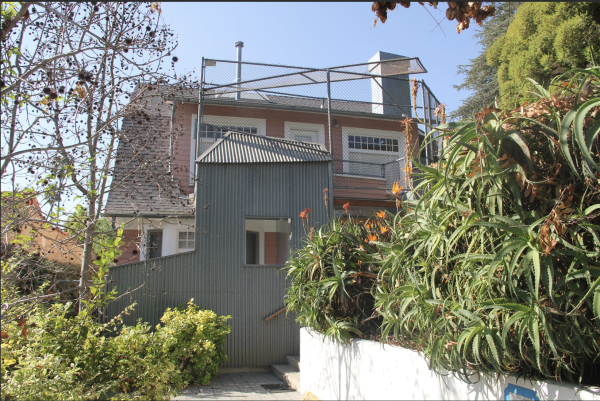
Gehry Residence – Santa Monica
Gehry’s house in Santa Monica incorporates many humble materials that show his expression.
His skylight enclosures really make this house unique.
Chain link––which, according to Andrew, is “the Gehry thing”––and corrugation along with the metal and concrete used show the industrial style vibe that you get from this house. He also uses thin pieces of wood that contrast his usual style of thicker wood.
This house is painted a salmony color and overall feels very geometrical.
Gehry has a “deconstructivist style,” according to Director of Advocacy at the Los Angeles Conservancy, Andrew Salimian.
Deconstructivist architecture is more chaotic and unsymmetrical. To me, its the definition of this house.
Edgemar
Edgemar is a shopping center designed by Gehry in the 1980’s.
You can really see with this building Gehry’s love for metal. A big metal box sits on the roof that Andrew says is “Pure expression. No function at all.”
This building also has a bold staircase that really sticks out with its thick metal angles.
Andrew couldn’t find a spot to pull over due to the crowdedness of main street on a sunny Saturday, so Zane and I hopped out of the car.
When we walked inside the courtyard area, I saw more details commonly found in Gehry’s work, such as chain link.
“Introducing a curve or even just turning a form of a box a little bit creates visual interest,” says Galambos.
All these features are just expressions, but without them, the whole design would be so different.
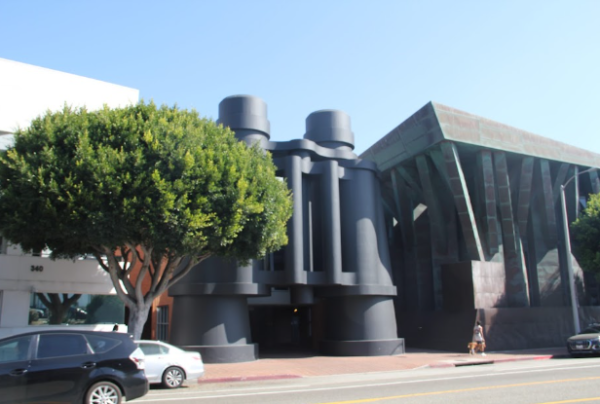
Binoculars building (Chiat/Day building)
This building stands out mainly because of the binoculars, which is actually a sculpture created by Claes Oldenburgh and Coosje van Bruggen.
Even though Gehry didn’t make the binoculars, his choice of not being afraid to incorporate them in his project shows his playful style that he was known for.
When we walked through the binocular entry way, I saw lots of copper which has started to become a green shade like the statue of liberty.
Andrew points out that the lower sides of the building––which are made from the copper you notice all around the sides of the building––look like people have been attempting to skate on them due to the fact they are covered in scratches and look like skate ramps.
The building to the right of the binoculars is supposed to resemble trees. The brown pillars look like tree trunks and there are more branch-like pillars coming off of the trunks.
Indiana Avenue houses/Arnoldi Triplex
This triplex was completed in 1981.
Each house was made with a different material on the outside. The first one is dark green shingles, in the middle is plywood, and the one in the back is stucco.
The shingle house has a really cool stair-like skylight feature which comes out at an angle off the front wall of the house.
The house next door, referred to as the Hopper house, was designed by Brian Murphy. You can see a big Gehry influence on that house with the whole outside being corrugated metal.
We wanted a better look so we walked around the side to a back alley behind the houses hearing the beatles blasting from whoever lives in the middle house now.
In the back alley behind the houses you can see a bridge that was built to connect the Hopper Residence to the triplex.
Norton House
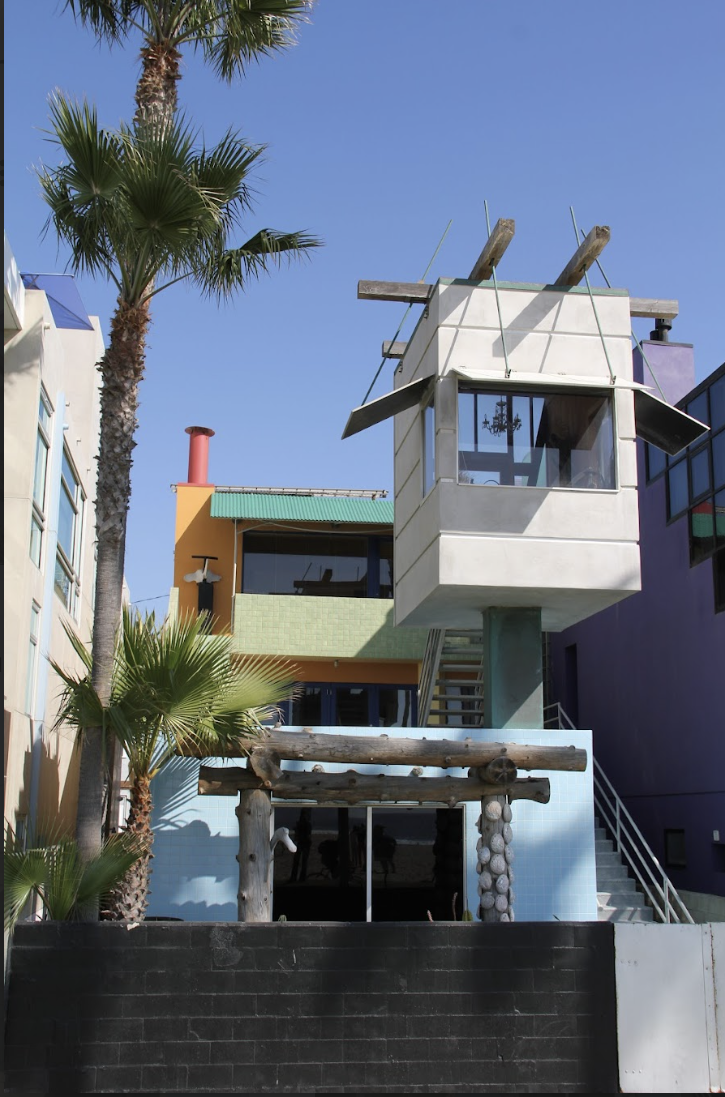
This house definitely shows the more playful style of architecture that a lot of Gehry’s works embody.
In front of the house a group of tourists were taking selfies, because just like us, they knew that it is actually a famous design they are posing with.
The bright shades of orange, blue, and greens make this house pop.
Again, he uses corrugated metal which a lot of his other designs include.
One of the many unique features of this house is the room that stands raised above in the front. This room is meant to resemble a lifeguard tower which is very fitting since the house is located just off the Venice Boardwalk overlooking the ocean.
“My feeling with Gehry is that he’s more of an intuitive architect,” says Andrew. “He’s not theory based.”
A lot of people in the world are theoretical and try to have logic for every little thing, but Gehry’s work teaches us a lesson to think outside the box more, whether that’s in architecture or in everyday life.