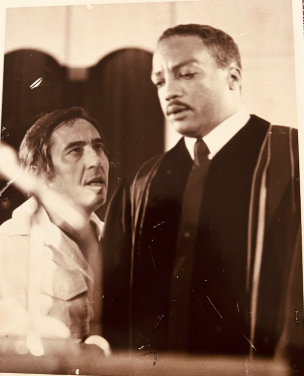
Earlier this month, I watched King, the 1978 dramatized miniseries on Martin Luther King Jr.’s life and career, directed by Abby Mann—my step-grandfather.
I watched it with my grandmother and had the opportunity to be enlightened about Abby’s journey creating the series and his special companionship with King.
As somebody who wrote scripts specifically to fight social injustice, his way of trying to change the world for the better, Abby Mann was driven by the idea of nonviolence. Having grown up in the time of the Holocaust in Pittsburgh, a city rife with antisemitism at that time, he was strongly influenced in his life and career by the values of justice, determination, and pacifism.
Of course, King’s concept of “nonviolence” extended far beyond any sentimental idea of “peace,” for King was a revolutionary—and in order to extinguish the flames of hate and racism, he needed to get very close to the fire. He understood that at the cost of great personal risk and danger, he could earn human rights for every African American.
But “peace,” to King, wasn’t about a clear sky nor the rainbow; it was about the imperative rain and thunder that preceded it. The notion of “peace” is not so concrete as it is an abstract idea and somewhat intangible end goal—what mattered was the process. The process of eliminating segregation and reducing racism certainly did involve violence and lives lost, but King made it a point to ensure that the violence would not be coming from him, demanding that his supporters follow his lead.
King was a prophet of his time, and I believe this is what made him so endearing to Abby. He’d always had a fascination with his bold activism and leadership, but it wasn’t until King came out against Vietnam that Abby fully recognized how brave King was. For no white elected official had yet the courage to speak the truth about the perils of such a war, let alone a solitary black man.
Despite all of the silent Americans, scared and unsure of the direction the war was going, King gave voice to the danger, despite that many tried to stop him. Abby could relate to this in his art. He had gone against unjust laws and popular public opinion many times to incorporate raw truth in his films—his priority was justice.
King was unrelenting in his criticism of Vietnam. He spoke out about the fact that black and white kids were dying for no reason in the name of a cause that had nothing to do with the American people. He understood the country’s xenophobic ambitions, knowing that violence and war would only feed the flame and deprive citizens of their lives for no good reason, and seized upon every chance he had to speak out against it. His ambition had always been to strive for nonviolence, as Gandhi had, in America, while fighting for equality for all the races in America and not the equity for just one.
The week of King’s anti-Vietnam speech April 4, 1967, Abby met with King for the first time to discuss the screenplay he was planning to write on his life. Abby met King with an introduction from famed actor Sydney Poitier, who was the initial casting choice to play Martin Luther King, but evolved given how young King was when he died and that it took ten years to get the movie made. King showed great interest in Abby’s pitch and his appreciation for his support of the movement. Abby flew down to Miami to attend a meeting of the Southern Christian Leadership Conference—destination which, when spoken by Abby, received a strange look from the cab driver taking him there, as not many white tourists visited the hotel King was staying at.
On that first encounter with King at the hotel, he noticed King’s humility above everything else. He wasn’t even sure it was King the first time he passed him.
Abby kept many parts of his life written, saving them as papers in anticipation of a potential autobiography. Many of his encounters with King were documented in this way, and as he writes he recalls his first impression.
“I finally stopped because he was indeed Martin Luther King but I had to look twice because he seemed to be so ordinary. I don’t know what I expected,” he wrote. “There was nothing of the mantle of the Nobel Prize winner about him or the triumph of a man who had stirred so much of the nation in his address of the Civil Rights march on Washington. When I introduced myself, he was warm and deferential if somewhat stiff, ‘Oh yes, you come under the highest auspices.’”
Later that night, Abby received a call from King, thanking him for the generous donation he’d left in the collection plate. He told him he’d been a fan of his film Judgment at Nuremberg, his Oscar winning film dramatizing the Nuremberg trials after the Holocaust. He said that on the day of the voting rights “Bloody Sunday March” from Selma to Montgomery, the movie had been broadcasted with interrupting reports on the violence taking place in Selma.
“Attempting to march peacefully from the small town of Selma, Alabama, to Montgomery, the state capital, to protest a brutal murder and the denial of their constitutional right to vote, six hundred people were attacked by state troopers and mounted deputies dressed in full riot gear,” writer Christopher Klein opined on History channel in 2015. “Nearly 50 million Americans who had tuned into the film’s long-awaited television premier couldn’t escape the historical echoes of Nazi storm troopers in the scenes of the rampaging state troopers.”
King respected Abby greatly and the feeling was reciprocated. He promised Abby that they were “really going to talk.”
Abby believed that King was the only great man he’d ever known, even if at that time not many seemed to agree. He proposed his finished screenplay to a number of production companies, each one turning it down. They treated King like a has-been, said he was finished, and made accusations that demonized him.
Abby shared his profound pessimism about humanity to King in their final meeting, “I’ve always thought of myself as an agnostic but every 24 hours I’m getting more and more to be an atheist in the world we live in.” King replied, “One thing I want to tell you about that, Abby. That was the only time in my life when I doubted there was an Almighty and that was in Nazi, Germany. Because if there is an Almighty, how could he have let that happen?”
He added, “I’ve regained my faith since but it’s not been easy. I still don’t know what I would have done about non-violence if I had lived then. How can I keep up my own people’s passion for justice without letting them do the most natural thing in the world, which is to strike back? I’m inadequate to it.'”
Some hours earlier that night, a cab driver had halted mere inches before King, nearly hitting him. They knew he didn’t want to stop. While Abby tried to lighten the mood in the cab, King wouldn’t let it go. He read the name “Sam Edelman” at the side of the cab. “Are you a Jew?” he asked. “Yeah. So what?” the cabbie replied. “You don’t deserve to be a Jew,” King said quietly, and by this I believe he was implying that out of all people, they should have each other’s back. When a person who experiences discrimination becomes prejudiced, it’s as though they learned nothing, or maybe too much from the wrong side.
Abby had wanted to change the world—being Jewish, the Holocaust had led him towards a stronger sense of justice, towards writing, Judgment at Nuremberg, towards that transformative energy from fear to creativity. Oppression was oppression; every victim of it is one in the same. If nobody had your back, Abby did.
Only unity can foster progression, but it seems that even now the country has been gutted by division and rejection of each other. King knew he would gain the support of African Americans, but he wanted to rally the whole country as well. Abby was Jewish, but his life had seared his consciousness with empathy for anyone that had their identity discriminated against. He centered his career around that empathy.
The news that King had been shot and killed came late in the afternoon, April 4, 1968. Abby tried to reach Coretta King or Andrew Young or anyone he could get a hold of, in a distraught frenzy. The whole country was erupting from the pain of his death. He tried to let it all sink in, recalling memories with King, mourning the loss of one of America’s greatest leaders.
Still, it seemed like King had long known he would end this way, for he had faced his own mortality many times. As he prophesied his own death in his famed Mountaintop speech, “I promise you as a people we will get to the promised-land. I may not get there with you.”
Then, again in a conversation with Abby, early on, where he’d asked King, “So how does the movie end, Martin?” And King replied with, “It ends with me getting killed, of course.” He was smiling, but he knew his foresight was correct, despite that Abby wasn’t so convinced of it yet.
Perhaps King knew that he might die this way from the first moment he opened his mouth to challenge oppression. He had once been a sneeze away from death after getting stabbed in Harlem at a book signing, with the tip of a blade at the edge of his aorta. His house in Montgomery had been fire bombed. The FBI, led by J. Edgar Hoover, had sent notes as an attempt to pressure him into committing suicide. He owed his life to advocacy; such advocacy would lead to his death. He’d been in danger since the moment he was born, but he had learned how to inhabit that danger in a prolific way.
“How could he have let this happen?”
Abby with his weak religion, and King as a former Baptist Minister and preacher. Yet they both to some degree knew that if this hadn’t happened, it was unclear what they might’ve achieved in their lifetimes, what legacy and impact they’d leave on their communities.
Triumph wasn’t smooth sailing, it was being spit out of a vortex back into the world, only to climb back in and repeat the cycle. Each of their victories were a product of the hell they faced—there would be nothing to prevail over if they hadn’t faced it. There would be nothing to teach the world if everyone was born knowing.
One decade after his death, “King” aired, February 12, 1978. Coretta Scott King wrote to Abby shortly after the Emmy Awards to express her gratitude both for the invitation to attend the event and for the miniseries, in all its permanence.
“Your willingness to tackle the story and portray Martin and other members of the movement as well as myself, indicates your commitment to his dream of peace, brotherhood, nonviolence, justice and equality,” she wrote. “The story of the movement is now before the public, in a way that only film can create.”