“In the name of tolerance, we should claim the right not to tolerate the intolerant,” said Austrian-British philosopher Karl Popper after witnessing the rise of fascism in Europe.
When we witness our country mirror the warning signs of the atrocities we learned in history class—masked agents taking people in our streets and citizens being shot under the guise of national security—it is intuitive to invoke this principle. We refuse to engage with ideas we perceive as “intolerant,” convinced that doing so legitimizes them and makes us complicit in allowing the mechanisms behind violence and hatred to run their course.
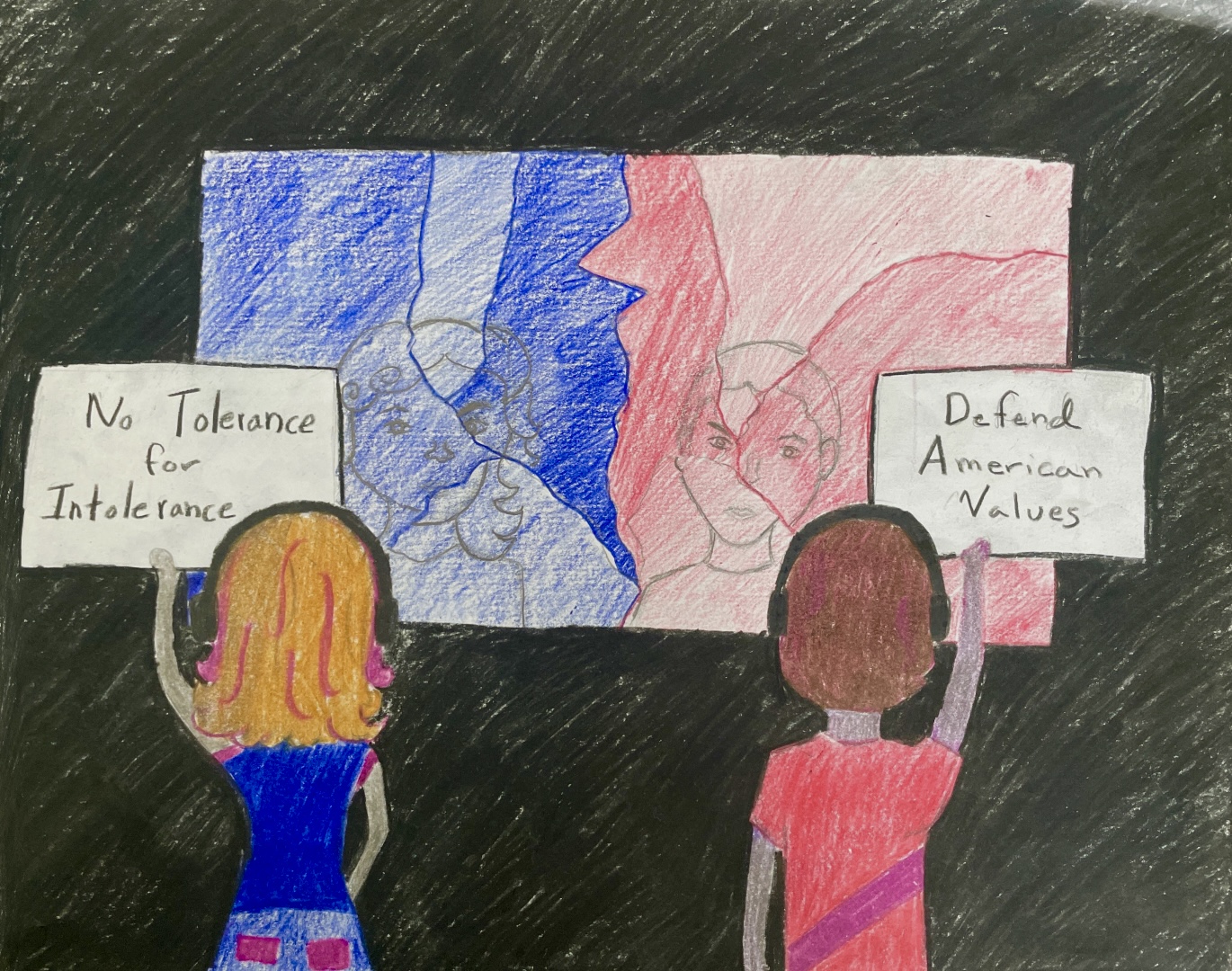
But in the name of righteousness, we might be contributing to the same divide that paints some people as inhumane.
Social media—the place where many students are the most exposed to politics—allows us to disengage with different viewpoints. Algorithms are meant to keep us engaged rather than informed, showing us content that either aligns with our ideology or is meant to provoke outrage, highlighting the most extreme views and leading many to believe that the gap is irreconcilable.
In online spaces especially, the language of policy is often paired with the language of morality. Calls to abolish ICE or to protect our borders are accompanied by accusations of racism, white supremacy, treason, and being “un-American.”
While it’s important to acknowledge the ethics and consequences of policy, when accusation immediately overtakes any concerns about policy, it becomes difficult to progress to a real conversation. When you are immediately identified as inhumane or a naive traitor, the opportunity to explain a viewpoint is lost.
This attitude can transverse into our real-life interactions where extremity is assumed and grey areas become dangerous battlegrounds. When not checking all the boxes for a certain stance is condemned as a sign of weak morals and lack of conviction in online spaces, voices who may have divergent opinions may be shut out of conversation in real life.
For example, within the pro-immigrant movement, those who want to abolish ICE may sternly differentiate themselves from those who are only calling for reform, some accusing the latter of perpetuating the violence we are witnessing now. By jumping to accusations at the forefront of conversations, people turn what could have been a point of discussion into a source of virtue signaling, inadvertently pushing away moderates who may have become allies.
When conversations become infused with shaming; silence, compliance, and division prevail. For some avoiding rebuke, adopting a certain stance becomes about social acceptance rather than conviction. Others opt to remain silent in real life and find comfort in digital spaces, where there is no duty to speak and disengaging with criticism is easy. Without truly safe spaces for discussion in real-life, there is little to counter the radicalization and resentment that forms in these self-reinforcing spaces.
If we leave no flexibility in our measure of intolerance—group everything associated with one side into a box to ignore and discard in the name of rectitude—we risk distancing people who might not be all that different from us.
According to non-partisan organization More in Common, we have a tendency to overestimate how much our views differ. On issues like immigration and law enforcement, the perception gap between what Republicans and Democrats think the other side believes is above 30%.
While 85% of Republicans agreed that “properly controlled immigration can be good for America,” Democrats estimated that only 51% would agree with the statement. 85% of Democrats disagreed with the statement “most police are bad people,” yet Republicans estimated that only 48% of them would disagree.
Social media engagement exacerbates this gap. Those who share political content have an average perception gap of 29, whereas those who don’t have an average perception gap of 18.
It is easy to share news on social media, to condemn actions, and to repeat slogans. It is harder to forge the conversations that allow us to see each other’s views more accurately and move forward as a more united front.
Slogans like “No one is illegal on stolen land” are effective demonstrations of unwavering support for a vulnerable population, but they reduce a complex issue to a moral declaration. They alienate those who may be concerned about human dignity but disagree over enforcement tactics and legal frameworks, painting the whole of the issue as a moral absolute where disagreement can be boiled down to hypocrisy.
I too am revolted and exasperated. I too want to scream. But I refuse to scream into an echo chamber where my only solace is sleeping in good conscience that my heart is in the right place.
It is easy to feel powerless in the face of such large and rapidly escalating problems, but as cliché as it sounds, we do have a voice. Perhaps not on a big stage, but in our communities and close circles, where trust and understanding is crucial to maintaining their integrity. In attempts to act sternly to achieve results now, we must not lose sight of the fact that we can build a better tomorrow, starting with the interactions we have day-to-day.
If we want to build that bridge, we have a responsibility to listen and address nuance. To consider the questions and concerns the other side might have without immediately inflicting scrutiny. To listen with the purpose of understanding rather than correcting. Because when we cease trying to understand others and lead with hostility, we begin to fuel the same “us vs. them” mentality that justifies violence and apathy towards others.
Not everyone will want to engage in genuine discourse, but it is better to give it an honest try than to rupture the mirror that helps us recognize our own flaws and the humanity of those both beside us and besides us.